Xinhua
10 Jun 2026, 14:45 GMT+10
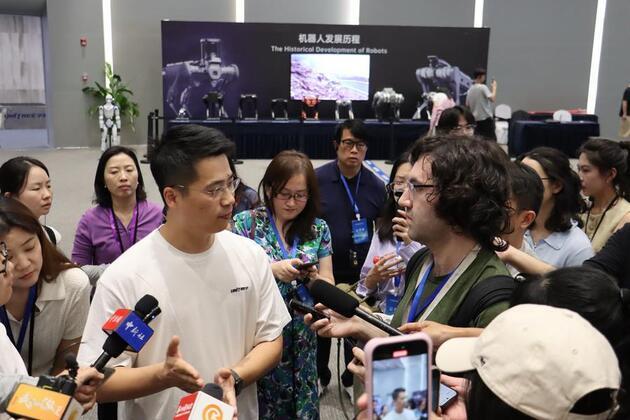
BEIJING, June 10 (Xinhua) -- A group of international journalists recently toured China's innovation hubs of east China's Zhejiang Province and the Chinese capital Beijing, where they got a firsthand look at some of the country's most advanced emerging technologies.
The journalists, from countries including the United States, Britain and France, took part in one of a series of reporting trips showcasing how China's innovation-driven development agenda is being translated into practice under the country's 15th Five-Year Plan (2026-2030).
Brain research is one of the fields that is gaining more and more attention on a global scale. Advances in this field are gradually unraveling the mysteries of the human brain and giving those who suffer from neurological conditions and physical disabilities new hope.
At the Chinese Institute for Brain Research, Beijing (CIBR), two brain-computer interface (BCI) systems developed by the institute drew the attention of visiting journalists.
Luo Minmin, director of CIBR, said that since February 2025, Beinao-1, a semi-invasive BCI system, has been implanted in 23 patients, which helps patients paralyzed by spinal cord injuries, strokes and other conditions regain motor functions, significantly improving their quality of life.
Beinao-2, an invasive BCI system, has reached the world's leading level in both accuracy and cross-day stability with its innovative decoding algorithm, according to Luo.
"The idea of having implants and being able to walk, talk and have a life again excites everyone," said Nelson Pancini de Sa, a journalist with Brazil's UOL Media Group, after seeing the two models.
He added that China's healthcare and pharmaceutical industries could emerge as the country's next globally leading sector.
Brain-computer interfaces represent only one aspect of China's push into frontier technologies. Across the country, a new generation of industries is rapidly moving from research to commercial applications.
One of the most closely watched areas is humanoid robotics. While many people around the world were first introduced to China's humanoid robots through their martial arts performances at the Spring Festival Gala, the technology has since advanced well beyond stage displays.
At renowned robot maker Unitree's exhibition zone in Hangzhou, journalists crowded around the displays, cameras clicking constantly as quadruped robot dogs leaped, rolled and maneuvered with agility. Nearby, humanoid robots took on the role of household assistants, seamlessly carrying out a range of tasks at the user's command.
"What we ultimately hope to do is deploying robots in dangerous and repetitive tasks, transforming the way people work and improving their quality of life," said Huang Jiawei, director of marketing at Unitree.
Such ambitions depend not only on increasingly sophisticated hardware but also on the vast quantities of data used to train robots to understand and interact with the world around them.
That process was on display at the Beijing Innovation Center of Humanoid Robotics, where visiting journalists watched more than 120 robots learning a wide range of everyday tasks, from organizing shelves and folding clothes to changing bedsheets, measuring blood pressure and tying shoelaces.
Once mastered, these skills can be shared across entire fleets of robots, accelerating the pace of learning far beyond what any single machine could achieve.
According to Xia Hualin, operation director of the center's data and training base, more than 30 application scenarios across six core sectors, from home, retail, office, to industrial, medical and elderly care, have been replicated at the center. The base collects more than 500 hours of real-world robot operation data every day.
The demonstrations also prompted a practical question among some journalists: if humanoid robots are eventually deployed on a large scale in factories, businesses and homes, can manufacturing capacity of robots keep pace with demand?
Part of the answer came at LY iTECH's super factory in Beijing. As the first embodied intelligence super factory in the Beijing-Tianjin-Hebei region, it provides one-stop manufacturing services for embodied AI systems, covering structural components, core modules, assembly and testing.
The factory, which began operation in May this year, aims to produce 10,000 humanoid robots this year, with annual output expected to reach 500,000 units by 2030, according to Yang Xinyu, vice president of LY iTECH.
"Just imagine a single factory producing 500,000 units a year, and they plan to build five such facilities. That's incredible," said Ananth Krishnan, a journalist with The Hindu, after hearing LY iTECH's roadmap.
The tour concluded with a glimpse of both the present and the future, revealing technologies already taking shape alongside the ambitions poised to drive China's next chapter of innovation.
In Beijing, officials outlined plans to accelerate the large-scale application of emerging technologies such as embodied intelligence and hydrogen energy, while speeding up the commercialization of 6G communications and brain-computer interfaces. The capital also aims to expand into frontier fields including superconductivity and space-based computing, according to Jiang Guangzhi, director of the municipal bureau of economy and information technology.
Zhejiang, meanwhile, is placing increasing emphasis on future industries ranging from AI and the low-altitude economy to humanoid robotics. The province aims to raise the share of value added from high-tech industries to more than 70 percent by 2030, further strengthening its position as one of China's leading innovation hubs.
Get a daily dose of Brazil Sun news through our daily email, its complimentary and keeps you fully up to date with world and business news as well.
Publish news of your business, community or sports group, personnel appointments, major event and more by submitting a news release to Brazil Sun.
More InformationRIO DE JANEIRO, Brazil: Rising fuel prices linked to conflict in the Middle East are putting pressure on airlines worldwide, forcing...
BEIJING, June 10 (Xinhua) -- A group of international journalists recently toured China's innovation hubs of east China's Zhejiang...
Over the past half century, bilateral ties between Suriname and China have continued to deepen, and cooperation has grown closer, said...
Pennsylvania [US], June 10 (ANI): Iraq suffered a 2-0 defeat against Venezuela in their final FIFA World Cup 2026 warm-up friendly...
Alabama [US], June 10 (ANI): Argentina captain Lionel Messi shared a series of pictures on his Instagram handle after the defending...
Alabama [US], June 10 (ANI): Defending champions Argentina concluded their FIFA World Cup 2026 preparations in emphatic fashion, securing...
SEATTLE, Washington: Amazon has signed a multi-billion-dollar agreement with Corning aimed at expanding U.S. production of optical...
NEW YORK, New York - Global stock markets closed with sharp divergences Tuesday, as U.S. indexes delivered a mixed performance while...
RIO DE JANEIRO, Brazil: Rising fuel prices linked to conflict in the Middle East are putting pressure on airlines worldwide, forcing...
CUPERTINO, California: Apple introduced a redesigned version of Siri powered by artificial intelligence, marking its biggest update...
SINGAPORE/LONDON: Indonesian President Prabowo Subianto is losing investors' trust, and his plans to grow the economy are at risk as...
NEW YORK, New York - World stock markets closed on a deeply divided note Monday, with Wall Street's technology sector powering the...